


I went ahead and put the original feature idea I’ve been pitching up on the corkboard.
Here’s my usual writing process for a new idea.
Have an idea
Give it a little room to breath without thinking too hard about it. See if it has any gravity. Do I keep circling back around to it? That’s the idea’s gravity.
Start jotting down notes to self in my notes app of choice (Evernote)
Come up with some comps and read / watch a few
Put down on paper the big moments, the scenes I feel like I have to see in this
Start to work on the surrounding architecture — ie, inciting incident, midpoint, act breaks, climax, or what I call the “Bare Minimum Outline”
Start to fill in between these pillars, so that I have an actual, functional outline
Once I have said outline, put it on notecards
Start writing
Then somewhere during step 9 I get stressed out, because none of steps 1-9 actually prepared me properly…
Somehow, despite many years of doing this, this is always what happens. And what I have come to realize, after, again, MANY YEARS of writing, is that this is because… my outlines were not very good.
I always used to describe myself as a “loose outliner.” Someone who likes to be surprised while writing the draft. To me, the most fun part of the writing process is the flow state I can find myself in, which tends to mean I am finding nice little surprises as I go. Some are small character moments, but some are bigger — diversions in plot, action, setting, etc.
And what’s not to like? Being surprised is fun! It makes the act of writing an act of exploration.
Well… I regret to inform you that surprising yourself halfway through can also accidentally derail the entire story and therefore your writing process.
I have compensated, over the years, by just “getting a draft down,” despite it veering off course, and sometimes halfway through that process course correcting, only to discover I now have two halves of a movie telling different stories, or two halves that exist in different tonal registers. And then, I will painstakingly be forced to examine my completed first draft and try to reverse engineer what it should really be.
This often means re-doing the outline, even after I’ve written a draft of the movie.
Which, is a rewriting process I still believe is valuable.
But, my time working in TV taught me exactly where the outline process was breaking down, and, believe it or not, it was at what I believed was the final step.
The notecards.
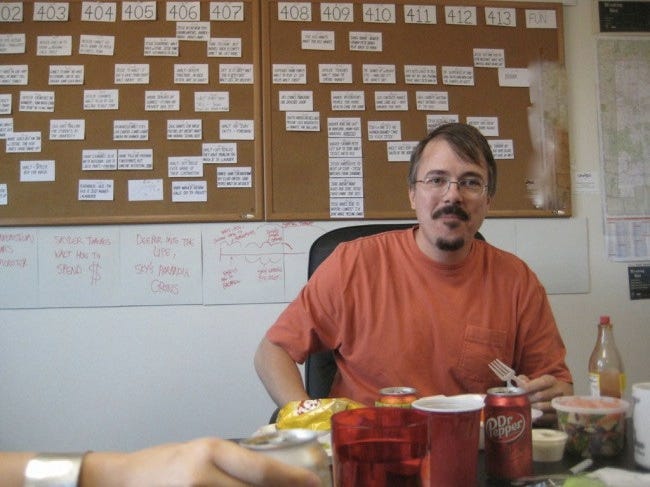
What’s going on up there? Well, that’s the outline of the story. It’s a breakdown of every scene / moment within the script. Some writers (Vince Gilligan, notoriously) are more detailed and put every single thing up there. Some writers are less detailed, and it’s more of a vibe check / note to self about what goes there.
My notecards, historically, were more vibe oriented. I’d have something like…
“Bruce & Laura talk it through at diner. She’s mad.”
Which is a totally fine signpost. Except! It’s not really telling us what happens in the scene. So, when I get to writing that scene, I end up with a tremendous amount of friction, because… I don’t really know what happens. Like… she’s mad and so… what happens?
Here’s a better version of the notecard:
“Bruce lets Laura know about him and Becky. Laura doesn’t want to hear it, goes to sit in the car. Bruce keeps eating.”
It’s not functionally different. The first notecard could easily become a scene in which the second notecard’s events happen. But, it is much more clear.
Both suggest conflict, but only notecard two delineates the cause and effect.
The cause and effect is what the scene is really there for.
A scene is not just a unit of screenplay. It is actually a transformation.
Take this boring diner scene —
We enter on the “status quo,” Bruce and Laura are on a date.
We proceed to the “event” of the scene, Bruce tells Laura about what happened between him and Becky.
Which results in a new status quo, Laura has left, and Bruce is alone.
Does this sound like the most interesting scene in the world?
No, I’m writing this as fast as I can so I can get back to work. I’m sure there are better hypothetical scenes out there.
But it IS a much better notecard.
Now, when I get to that notecard I have specific action (for both characters!), specific setting, specific event (Laura gets up and leaves), and, a much easier time writing the dang scene.
Should this distinction have been obvious? A good solid beat in an outline vs a kind of flimsy one? Maybe? But for some reason I don’t think this differentiation was ever made perfectly clear to me. Until I worked in television.
In TV, because you are writing the notecards together, they absolutely must be clear and communicable, to anyone on the staff, so that any writer could pick up the notecards, bring them into their office, and start writing.
If the notecards are just placeholder vibe checks, you end up with a very challenging writing process.
If the notecards are even just a bit more specific about the cause and effect that takes place within a scene, it’s going to be so much easier.
And, best of all, that specificity is going to tell you whether you actually have a scene or not.
Because without cause and effect, you really just have a shot and a vibe.
So, now I have revised my writing process, and here’s what it looks like:
Have an idea
Give it a little room to breath without thinking too hard about it. See if it has any gravity. Do I keep circling back around to it? That’s the idea’s gravity.
Start jotting down notes to self in my notes app of choice (Evernote)
Come up with some comps and read / watch a few
Put down on paper the big moments, the scenes I feel like I have to see in this
Start to work on the surrounding architecture — ie, inciting incident, midpoint, act breaks, climax, or what I call the “Bare Minimum Outline”
Start to fill in between these pillars, so that I have an actual, functional outline
Once I have said outline, put it on notecards
Revise the notecards to be crystal clear
Start writing
Now, obviously, it takes time to get the notecards to be crystal clear. It means you are spending way more time in the outline. And that can be… boring. But let me tell you, as someone currently working on a new draft of a new script, this one small addition has been transformative…
Hope it’s a helpful distinction for the rest of you out there.


As always, very helpful advice. Thank you, Colby!