

Why is Widow's Bay so good?
And how do we as writers steal from it?

I was having lunch with a friend and we were talking about having recently finished all the “new good shows.” Things like Maximum Pleasure Guaranteed. DTF St. Louis. Widow’s Bay. And the fact that we’re both craving a new hit of that “good TV show” energy. So if you have a new good show you’re enjoying, let me know in the comments.
But in the meantime, in order to recapture a little bit of that TV Magic, I want to dig in on the big weirdo surprise hit of the season, Widow’s Bay.
I think there’s a lot we can learn from what works well in the things we love, and can’t help but watch everything with an eye towards “what can I steal from this for my own work?” It’s the curse of being a writer, but also, unavoidable, and so let’s just go with it. Longtime readers will remember me doing this same exercise with Slow Horses. I can’t help myself.
If you haven’t seen Widow’s Bay on Apple TV yet, I will try my best not to post spoilers here, but you should watch it. And if you can catch up in time, the final three episodes will be screening in theaters (in select cities) August 12th??? Weird but cool!
So let’s get into it. What exactly is it that makes Widow’s Bay so good, and how do we capture that lightning in a bottle feeling for our own work?
We love a mashup.
The classic Hollywood thing is “it’s THIS meets THIS.” And it’s classic for a reason. There is something delightful in being able to be surprised by a show/movie that manages to do something “familiar but different.” Familiar but different is, in my opinion (and as I’ve written about before here) the secret to a successful pitch in Hollywood. Familiar means I can picture the poster. Different means I can tell my friends “oh my god you have to see…” What makes Widow’s Bay such a successful mashup is that it’s doing it on multiple levels. It is a genre mashup — spooky suburban horror meets workplace comedy. It’s also a mashup of component parts within its horror side — the “curse” that animates the entire action of the series means that the show can have its cake and eat it too, giving us all sorts of different myths, monsters, ghosts, and sea hags. It’s like every Stephen King idea got crammed into one little town. Perfect.
We love characters who are in over their heads.
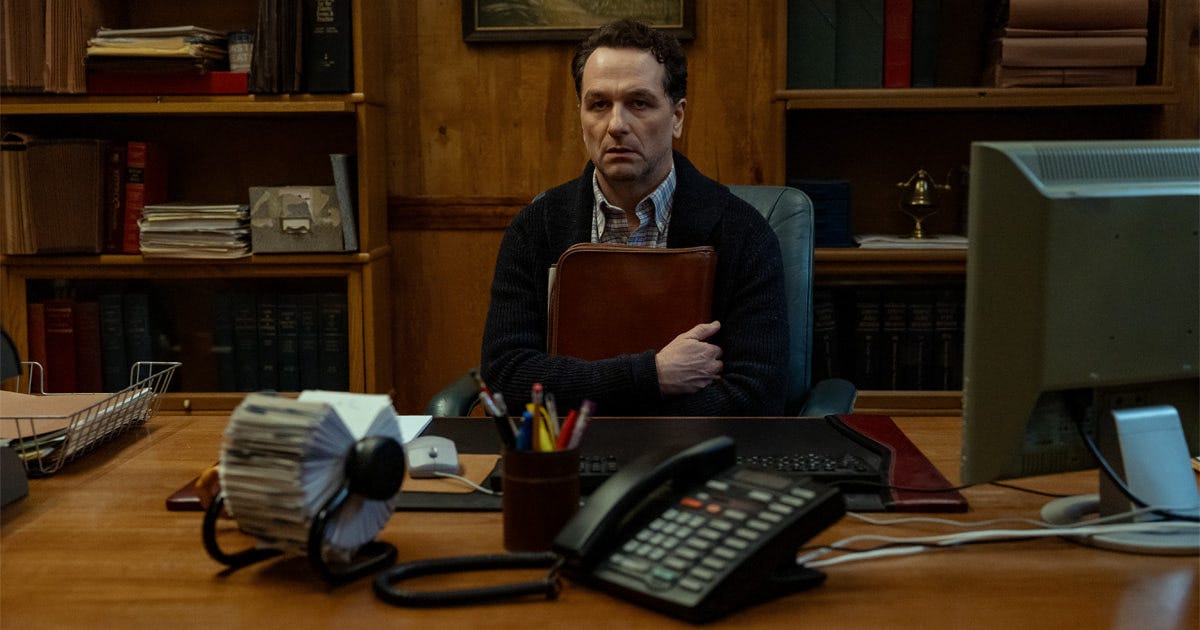
It’s hard to be the mayor of a small town. Especially of a small town with very dramatic locals. Oh and a curse. Getting to see Matthew Rhys sweat, basically for the entire runtime of the series, is delightful. And there’s nothing like “shit I don’t know what to do here without something terrible happening” to get me as a viewer to lean in and want to see what happens next. Because I want to see the terrible thing! Or the surprising way out of the terrible thing! Either way, I’m into it. And Widow’s Bay nails that conundrum from the start, and continues to tighten the screws on its characters throughout, giving them an increasingly complicated problem to work out throughout.
We love our weird coworkers.
I’ve said it before and I’ll say it again: TV is about hanging out with our friends. When you spend hours with the same people, week after week, you can’t help but like them, whether they’re Tony Soprano’s vain, neurotic hitmen, or Ruth, the elderly and confused secretary of Matthew Rhys’ Mayor Tom.
The thing that makes great TV great is the ability to build out a very deep bench of strange and compelling characters. What’s the good test for whether your characters are interesting enough? Could they be paired with any other character in the show and have it be a compelling scene? Could they carry the weight of the main storyline of an episode? Widow’s Bay does an incredible job of creating a deep bench of interesting (and interesting looking, big bonus points!!) characters, and also gives them all time to shine. It’s impressive characterization, and it makes it feel all the more real, and all the more strange. And that’s what fosters that “I can’t wait to see my friends” feeling you want a good show to give you.
We love a mystery.
At its core, serialized television is about mystery. What is going to happen next is the fundamental engine of all TV, but there’s a reason so many successful shows depend on a larger mystery. Mysteries are inherently sticky. We want to solve them. We crave answers! And so starting your show with a big unknown that will slowly need to be unraveled over the course of one (or many) season(s) is a very good strategy for getting us to come back week after week. But you can’t cop out on the mystery element. If you’re doing a mystery you do eventually need to get to the bottom of things, and then you need to know how to keep things going anyway. Which… I’m not posting any spoilers but it seems to me like the Widow’s Bay creative team have figured out.
We love being scared.
It’s a similar principle to the mystery thing. Human beings just like thrill rides. We like getting that little adrenaline rush. And Widow’s Bay manages to craft some genuinely creepy moments in each and every episode, regardless of how silly it can also be.
Anything I missed? What else does Widow’s Bay do well? And how do we learn from it to make our own writing pop? Let me know in the comments.
In other Hollyweird happenings:
Thank you to the paid Hollyweirdos who showed up to this week’s Zoom session. Was really fun getting to talk together about multiple protagonist stories, why everything is moving so slowly in Hollywood, and get a bit philosophical about how to enjoy writing when the career ladder seems… broken. If you’d like to join September’s hang you can upgrade your subscription here.
I’m still pitching my “sad fake dad” idea, while also writing it on spec since pitching takes so long, and I’m trying to be prepared for the inevitable post pitch outcome of a lot of places saying… “we really like it, we just need to see the script.”
Spider-Man raked in a cool billion. Hopefully this isn’t the takeaway. Though I am tech avail to write Labubu the Movie. I have a very exciting take.