

Your climax doesn't need to be "bigger"
it just needs to answer one question

I’ve been pitching this movie and the feedback has been good but still no real bites. Part of this is the marketplace. It’s extremely challenging to sell an original idea without a script. Part of this is the pitch itself, which I’ve been slowly modifying with each meeting, and as I continue to noodle through how I will ultimately write this movie.
As I’ve been re-conceiving the movie (I changed a lot about the first and second acts recently) I’ve focused on two things. I tried to make the character’s transformation much more clear. And I’ve tried to make the action of the film much more fun. With bigger, escalating action throughout. But, about an hour before my next pitch, I ran through it again to try to incorporate all this new stuff and realized: the ending doesn’t work.
It just didn’t feel satisfying. In fact, after all the new stuff throughout, it felt kind of deflating. “That’s it?”
The emotion and intent of it still felt right. The ultimate conclusion. But the climax itself, the big final moments of the film, didn’t feel all that big. And didn’t feel very satisfying.
Why didn’t “the hero ultimately triumphs” feel satisfying?
It’s easy for the first instinct to be, “it’s not big enough.” More action. Higher stakes. Turn the dial up to 11. And, that’s worth checking, yes.
Are the stakes big enough? Is the action bigger / more interesting than previous spectacle within the film? My ending had always been good guy fights and defeats bad guy (this is an action movie so we’re talking literally here).
Here’s what the real problem was: the ending wasn’t delivering on the film’s main thematic question.
As I’d worked on better establishing the protagonist in the first act, and giving him more active ways to overcome a series of escalating challenges in act two, I had also sharpened for myself what this movie was really about. In this case, it’s a movie about a man who’s up against a system, the machinery of it all. And by the time I was getting to the climax, that system had dropped away. In trying to be clear about “good guy fights bad guy” I’d accidentally dropped them in a void, rather than keeping them actively within the thing that the entire movie up to that point was about.
The giant laser beam problem.
You’ve seen it before. The giant beam of light shooting down from the sky to signal… “this is the big world-shattering conclusion of the movie.” It is in… a lot of movies.
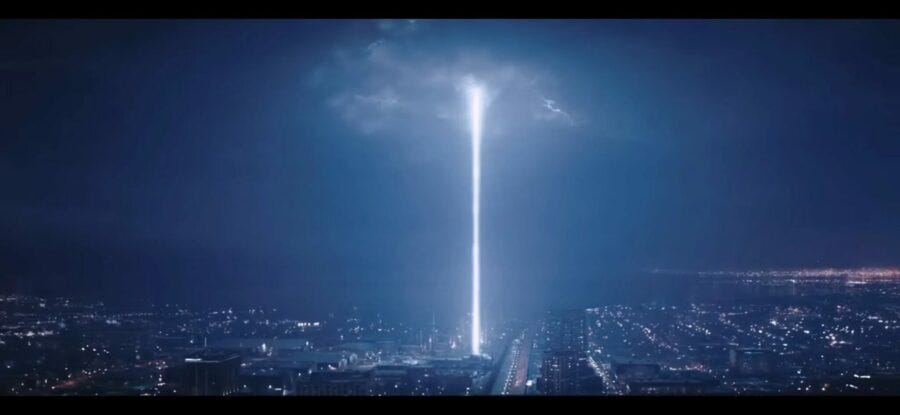
This is a setpiece being scaled up. And it doesn’t always work, or feel particularly satisfying. Not because it’s not big enough. It is in fact hard to imagine larger stakes than… giant beam of light is going to destroy the planet/world/universe/multiverse. But the real reason it can feel a little bit hollow is that it’s not tied down to anything specific. This is scale without specificity. An action set piece in a void. Sometimes in the case of superhero movies this is a vacant alien landscape or a giant vacant nondescript area of industrial seeming land.
This kind of unmoored action often falls flat. Not just because of the geography, but because of its thematic meaning. What does the giant space laser represent? How does it tie back to the theme of the movie? How does it allow the hero to demonstrate their emotional change throughout the course of the story?
Compare these kind of “good guys fight bad guys to save the world” climaxes with something that’s a lot smaller, but a lot more effective.
Let’s look at the end of The Terminator.
Okay so… spoilers for The Terminator (1984).
After a very intense chase / fight / chase The Terminator has cornered our heroes in this… factory? They fight, and ultimately, defeat The Terminator. The climax itself is actually kind of small. Sarah Connor is cornered, the Terminator is coming after her, and she ultimately uses a giant smashing machine to crush and destroy the Terminator. Hero defeats villain. Cue the denouement.
Okay so… hero defeats villain one on one. Check.
But here’s what The Terminator is doing in that conclusion. It is directly in conversation with the premise of the film.
Can you survive when an unstoppable killing machine is out to get you?
In Sarah Connor’s case, yes, barely. In Terminator 1, 2, 3, (not 4), 5, and 6!
Let’s also look at the ending of Raiders of the Lost Ark. A movie that famously HAS a giant space laser!
[Wow ok thank you JoBlo for the terrifying key art here.]
As a refresher: Indiana Jones has fought the entire movie to try to get the ark of the covenant away from the Nazis because… well… he doesn’t like Nazis very much. But by the climax of the film, Jones is incapacitated. And the action proceeds almost as if he’s not there at all. They open it up and it kills them all (and a giant beam of light shoots up into the heavens).
Why does this ending feel satisfying?
We don’t need Indy to fight the giant space beam, or fight the strange biblical ghosts, or to fight anyone at all. All we need is for Indiana Jones to recognize that, as skeptical and as pragmatic and as gruff and “I don’t go in for all this hooey” as he begins in Act One, by the end of the film he has changed. Now he’s afraid of the ark. He respects it as an object, and as an object that nobody should possess.
He started the movie as a guy who steals artifacts so somebody can have them, but over the course of our movie has become somebody who respects what is actually sacred about these objects.
Which makes the climax ultimately satisfying in answering both the dramatic question of the film and showing us how the character has changed over the course of this journey!
Good job Indiana.
That Terminator clip answers the plot question (while showing us just how much Sarah Connor has changed). That Raiders clip answers how the character has changed (while answering the plot question of “can we keep the Nazis from getting the arc?”).
The best endings do both.
So, that's the real test. Not "is this the biggest scene in my movie." But rather "does this scene pay off the specific promise my premise made in act one, and fire it do that while showing my character’s growth?"
And that’s the real reason my ending felt like it wasn’t working anymore.
The fix, in practice
Once I zoomed out and thought about the ending, I could see my “good guy vs. bad guy” fight was entirely divorced from the premise of the movie. So I had to find a way to fold back in the system element that had fallen away — “Can you still do good when the entire system is designed to keep you from doing that?”
I re-crafted the climax to get the hero to be fighting (and defeating) not just the bad guy, but a physical manifestation of the actual dramatic question of the film.
Now my ending was bigger, yes, by virtue of simply changing the geography, but, more importantly, it was also directly connected to the film’s theme. It directly answered the questions established in the first act. And it felt more satisfying, because we’ve hopefully spent the entire story wondering… will this thing happen? Will our hero be able to overcome the world, the antagonist, and ultimately himself in order to get through the events of the movie? The climax tells us, yes, here’s how.
An hour later, I pitched the movie.
I think it went well.
The question to ask of your own climax
Next time your ending feels smaller than it should, don’t reach for scale first.
Reach for this instead: what is my premise's specific promise, and who does my hero have to become to finally answer it? If your antagonist could be swapped for a generic bad guy and the scene would still basically work, or your hero could win this scene without having changed at all, you don’t have a climax yet.
You might just have a fight scene set underneath a giant space beam.
This newsletter runs on paid subscriptions, that’s just the mechanics of how I can keep doing it instead of it being the first thing that falls off my plate. If this one was useful, you can upgrade your subscription here.
And when you do… you’ll also get access to the monthly Hollyweird Hang, where paid subscribers bring me the actual messes they’re up against — the pitch that isn’t working, the ending that feels hollow, the thing they can’t quite diagnose alone, and we work through it live.