

Writing as Exploring
No creative work is actually wasted

Hello Hollyweirdos!
For the last few months, for those of you paying attention, I’ve been writing a feature film, then writing an episode of a television series, and now we have come to the moment when I’m finished writing both and have been tasked with starting to rewrite both of them at the same time. Of course it would work out this way. It never doesn’t work out this way. So I am looking this week at a lot of notes.
I’ve written before about notes, both how to give them, and how to best to take them (in my experience), but even more important than the practical “How to,” there is some personal emotional preparation that I think all writers can work on to best be prepared for the moment when you basically have to start over.
In my now decade plus long career as a professional screenwriter (and as I was reminded the other day nearly twenty years of actively “being a writer” yikes) I have gotten all kinds of notes: good notes, bad notes, comprehensive notes, paper thin notes that don’t really stand up to any scrutiny whatsoever, notes that indicate the people giving the notes never actually read what they’re noting, and “just a tiny tweak” notes that actually blow up the entire thing and demand starting over.
There is both an artful science to parsing which notes are good, which notes are bad, and which notes are neutral, which I really do believe is the key to handling all notes on projects. But let’s assume you already have processed all of the notes, and now you find yourself at the point where the most truthful notes all indicate that you’re going to do the thing all writers dread. Start over.
This can feel demoralizing. “Why all this wasted effort? Everything I’ve done so far has been for naught!” Makes sense. Writing is a lot of work and the dreaded “Page One Rewrite” means doing all that work, again. We as human beings hate the idea that work has been pointless. (This is one of the ever-expanding reasons the “AI Bubble” is a social nightmare. When we make work truly meaningless, it will deny a lot of people their main source of meaning. And make them retroactively feel that their entire lives have been meaningless. Not great for society, IMO!)
As a writer, when the feedback means you’re going to need to start over basically from scratch, it is easy to conflate that with “my work so far has been meaningless.” But I really do contend that with writing in particular, this is not the case. No creative work is meaningless.
In fact, I would argue that one of the best things that can happen from a draft of a script, whether it’s for film or television, is that people read it and determine “oh we don’t actually want that, we want this other thing.” Clarity! At last!
The process of writing something new is one of exploring, a dark, seemingly boundless territory, and slowly beginning to map it out. A wall here, a rock formation there, an exciting third act set piece involving jet skis.
In a first draft, we are Lewis and Clark, exploring the vast unknown (to us) geography of North America. [Of course that vast unknown geography was very much known to the people who already lived there, but we simply do not have the time or space in this weekly newsletter about writing to contemplate what “exploration” has meant in human history.]
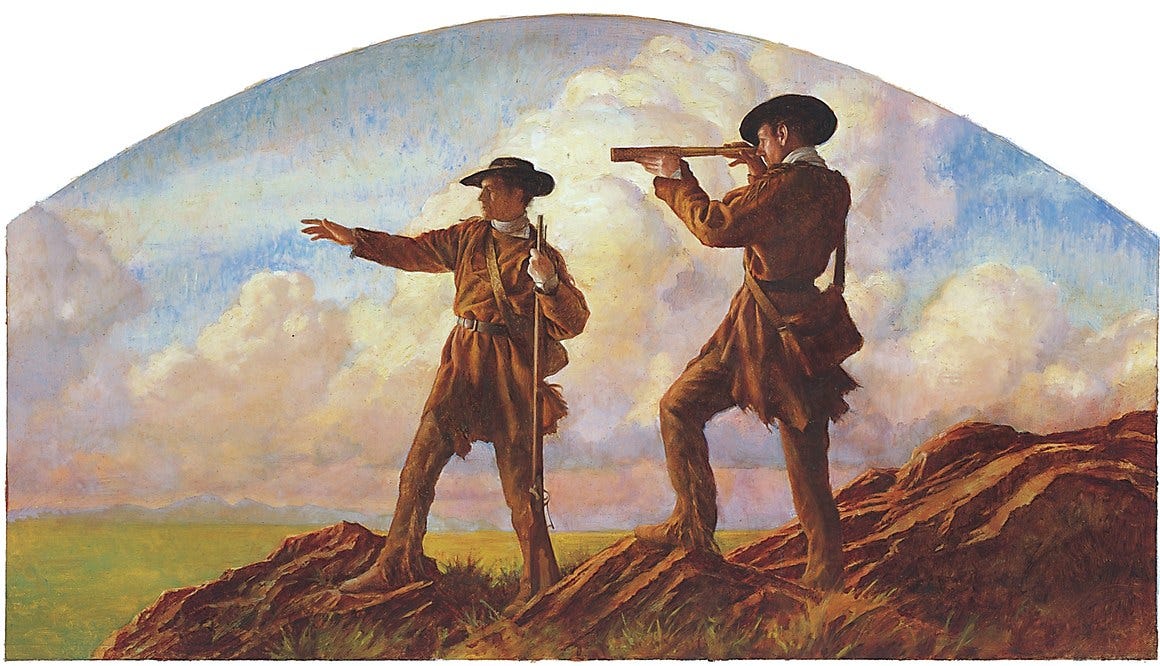
Heading across the continent once is not really sufficient for successfully and completely mapping the geography. All we’re seeing is what presents itself to us in our limited field of view as we move from idea to outline to draft. There is a vast, uncharted world of story possibility just over the horizon, and we may need to cross the continent many more times in order to properly scout it all.
So I would reframe the page one rewrite. It is not an indication that “none of that work meant anything,” but instead “we need further exploration.”
You aren’t actually checking the map in the bin, but instead trying to find a more elegant pathway through the mostly still unknown. And with each wild re-calibration, we are hopefully getting closer and closer to the best path available, rather than simply first one we decided to try.
Now, is exploring a vast continent over and over fun? Not always! Is it easy? No. Is it what we intended to do when we set out to go from A to B as quickly and efficiently as possible? Certainly not. But exploration is exactly what we are doing when we set out to create.
Is this ultimately just a kind of mental gymnastics? Absolutely, yes. Does it make it a little bit easier when faced with a note that fundamentally tears the back half of your film apart? Also yes.
This kind of flexibility is on my mind lately, clearly, as I recently made a video about the fact that I think this is one of the most valuable assets collaborators can have.
Film and television, which require tens of thousands of decisions, and allow for thousands of opportunities for things to go wrong and require a pivot, are not mediums that allow for rigidity. In a very high stress environment, rigidity will mean collapse. Flexibility is strength.
So, as I head into rewriting a feature film in a way that is going to require a lot of use of the delete key I thought it might be nice to remind myself to stay flexible, avoid rigidity, and be open to finding an entirely new path to the destination.
Which all is a great segue, to the fact that I am going to need to move our monthly zoom hang Q&A. Yes I know it was supposed to happen today.
I cannot make this happen today, unfortunately, so let’s push it to Sunday.
The Hollyweird Hang will be Sunday at 11 AM PT / 2 PM ET.
These zooms are for paid subscribers of the newsletter to ask any and all writing/craft/career/business questions and for me to do my very best trying to answer. I’ll send the link out to paid subscribers on the day, so if you want to join, you still have time.
I apologize for the late notice but there is A LOT going on over here, and if do happen to log on this Sunday I can tell you all about it.
More soon from the unmapped territory of Writing World.


are these hangouts recorded? Thanks